
Buying Hotel and Spa Fragrance From China: A Procurement Checklist
A hotel or spa fragrance line is bought by procurement, judged by guests and audited by whoever handles safety and waste. Those three audiences want different things, and a China sourcing checklist has to satisfy all of them at once. The sequence below keeps a first hospitality order from collapsing into a debate about whether the scent or the paperwork was agreed first.
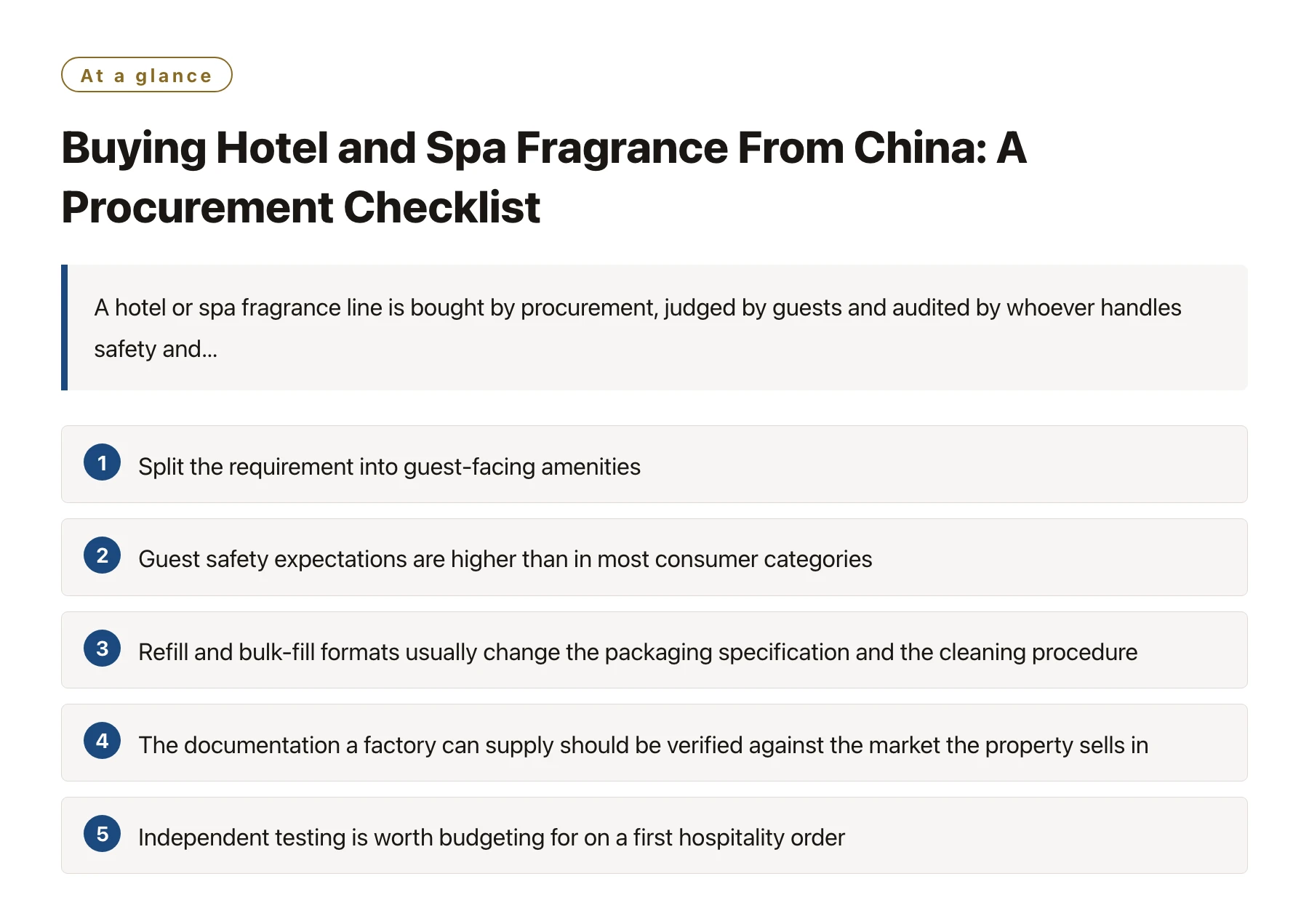
Key takeawaysSplit the requirement into guest-facing amenities, retail take-home products and back-of-house scenting, because each has different volumes, packaging and documentation needs. · Guest safety expectations are higher than in most consumer categories, so the safety assessment and material statements belong in the first conversation, not the last. · Refill and bulk-fill formats usually change the packaging specification and the cleaning procedure, so decide the format before the bottle. · The documentation a factory can supply should be verified against the market the property sells in, because obligations differ by jurisdiction [1]. · Independent testing is worth budgeting for on a first hospitality order, since it converts a supplier statement into evidence the brand can hold [2]. · A property group that operates in more than one country should map markets to documentation at the start, rather than discover the difference at the customs stage [3].
Hospitality sourcing carries a constraint that most consumer fragrance projects do not: the product is used by people who did not choose it. A guest did not read a label before the shampoo appeared in the bathroom, and a spa client did not compare ingredients before the oil was applied. That context raises the standard for safety documentation and for consistency, because a guest's only experience of the product is the one bottle in their room.
This checklist is written for the person running the procurement: what to define first, what to ask a Chinese manufacturer for, and what evidence to hold before the first delivery arrives at a property.
Start by separating the three product streams
A hospitality fragrance programme is rarely one product. It is usually three: fixed amenities for guest rooms, retail products the guest can take home, and scenting for shared or back-of-house spaces. Each has its own volume pattern, its own packaging constraints and, in many markets, its own labelling requirement.
Treating them as one line item is the most common early mistake. Room amenities need predictable replenishment and tamper-evident packaging; retail products need barcodes, price positioning and packaging that survives a shelf; spatial scenting needs a delivery method that does not require staff attention. A single supplier conversation can cover all three, but only if the brand brings three briefs rather than one.
The procurement sequence for a first hospitality order
- Define the property inventoryRooms, suites, treatment rooms, public areas and retail spaces, with the item count per room and the replacement cycle. This is the number that drives minimum order quantities and the packaging format.
- Choose the scent routeA library accord produced to your specification is usually faster and cheaper for a first programme; a developed signature scent takes longer but is harder to find elsewhere. Decide which matters more before sampling.
- Fix the format before the bottleRefillable, bulk-fill or sealed single-use changes the container, the closure, the cleaning procedure and often the labelling. Format first, then packaging.
- Collect the documentsSafety assessment, material and allergen statements, batch records, and any test report relevant to the product type. Confirm which party provides each one and by when.
- Agree labelling per marketList every country the property group operates in and confirm what each requires. Differences are easier to absorb at the artwork stage than at the customs stage.
- Plan the replenishmentAmenities are consumed continuously, so the reorder rhythm matters as much as the first order. Agree lead time, buffer stock and who holds it.
What to verify for each hospitality stream
| Product stream | What matters most | Evidence to hold |
|---|---|---|
| Guest room amenities | Consistency across batches and tamper evidence | Batch records, fill specification and retained reference |
| Spa treatment products | Compatibility with professional use and dilution where relevant | Safety assessment, usage instructions and stability data |
| Retail take-home products | Shelf presence, labelling and price positioning | Artwork approvals, barcodes and market-specific labels |
| Public area scenting | Delivery method and maintenance burden | Equipment specification and material safety information |
The third column is what a procurement file should contain after the first delivery. If an item in that column does not exist yet, it is worth naming an owner before the order is placed rather than after.
Where hospitality projects lose time with a Chinese supplier
The first loss is format indecision. A property that cannot choose between refillable and sealed formats will receive quotes for both, and the comparison will stall because the two are not comparable on unit cost. Fixing the format early usually collapses the quote stage from weeks to days.
The second is documentation scope. A supplier can describe what it normally provides, but the property's markets determine what is actually required. A brand that maps markets to documents at the start avoids the situation where artwork is printed before somebody notices that a market needs a different label.
The third is sampling logistics. Hospitality lines often involve several items that must smell coherent as a set: soap, shampoo, lotion, room mist. Evaluating them one at a time misses the point, because the set is what the guest experiences. Ask for the samples as a set, evaluated together, on the same day.
The fourth is the assumption that a consumer-facing factory is automatically set up for hospitality volumes and packaging. Some are. A partner that works as a contract manufacturer for perfume brands may serve both, but the question to ask is specific: what is the smallest amenity-format run, and what does the fill and packing line do differently for it.
For a property group that wants its own label rather than a developed scent, the route is closer to private label work, and a supplier operating as a private label partner for perfume lines will usually have a library and a packaging range to choose from. That is a faster path to a first delivery, at the cost of differentiation.
The sourcing decision itself comes last, after the requirement is clear. a Chinese factory for perfume brands is a starting point rather than a conclusion, and the questions above are what separate suppliers that can support a multi-property rollout from those that can fill one order well.
Before signing, ask the supplier to describe the first delivery in reverse: which documents travel with the goods, which stay with the factory, and which items the property must produce itself. If that description has gaps, they will appear as delays at the property rather than at the factory, and the operations team will be the one explaining them.
Sources
- European Commission: Cosmetics in the EU —— The European Commission's overview of EU cosmetics rules, including the responsible person, product information file and safety report requirements.
- SGS: Cosmetics, Personal Care & Household Testing —— Testing, inspection and certification services for cosmetics and personal care, including microbiological, stability and safety testing aligned with cosmetics GMP.
- Health Canada: Cosmetic Safety —— Health Canada's cosmetics pages, covering cosmetic notification, the ingredient hotlist and safety requirements for cosmetics sold in Canada.
Frequently asked questions
What is the minimum order for a hotel amenity fragrance line from China?
It depends on the format and the packaging, because sealed single-use items, refillable bottles and bulk containers have very different minimums. A first programme usually starts with a library scent and a standard container to keep the minimum manageable, then moves to custom packaging on reorder.
Do hotel and spa products need the same documentation as retail cosmetics?
They are generally cosmetic products and are usually subject to the same market rules, though the specifics differ by jurisdiction and by product type. What changes in hospitality is who holds the file and who can be asked about it, so the responsibilities should be written into the supply terms.
Should a property group develop a signature scent or use a library accord?
A signature scent supports brand identity and is worth developing where the property competes on atmosphere. A library accord is faster, cheaper and easier to scale across many properties quickly. Many groups develop one signature scent and use library accords for secondary product lines.
How should amenity samples be evaluated?
As a set, on the same day, in conditions close to real use. Shampoo, soap and lotion are experienced together, and a scent that is pleasant in isolation can clash with the product next to it. Record the evaluation so that a later reorder can be compared against it.
What should be agreed about replenishment before the first order?
Lead time from order to delivery, the buffer quantity held by each side, the reorder trigger and the process for a mid-season volume change. Amenity consumption is continuous, so a plan that covers only the initial delivery tends to produce an emergency order within a few months.